The success of a space isn’t just about how beautiful it looks on Instagram; it’s about how well it adapts to the movements of the humans living inside it. Have you ever noticed that in a truly great room, reaching for a glass is effortless, walking around a bed feels natural, and you never bump your elbows?
That invisible comfort comes from the holy text of the architectural world: Ernst Neufert’s Architects’ Data.
Neufert based his entire philosophy on anthropometry—the proportions of the human body—to determine the ideal measurements for furniture and rooms. From your living room to your bathroom, here is a breakdown of the critical Neufert dimensions that dictate a well-designed home.
1. The Core Philosophy: Human Scale (Anthropometry)
In design, everything begins with the “average human.” Neufert mapped out exactly how much space we take up when we stand, reach, and sit, forming the baseline for every piece of furniture you own.
- Standard Human Height: Designs are generally referenced around a person who is 175 cm tall.
- Eye Level: About 160-165 cm when standing, and 115-120 cm when sitting down.
- Shoulder Width: Averaged at 60 cm. (This is the golden rule that dictates the width of your hallways and doors).
2. Living Room Dimensions
The living room is the hub of social interaction. The biggest rookie mistake people make here is cramming furniture too close together or pushing it awkwardly far apart.
Sofas and Seating
- Seat Depth: For a comfortable sofa, the actual seat cushion depth should be between 50-60 cm. However, factoring in the backrest and the tilt, the total footprint of the sofa will require about 80-90 cm of depth in your room.
- Seat Height: 40-45 cm off the ground is the sweet spot.
- Circulation Space: If people need to walk between two armchairs or sofas, you must leave a minimum of 60 cm of empty space.
- Coffee Table Distance: Keep your coffee table 40-50 cm away from the sofa edge. This is close enough to grab your coffee, but far enough away that your legs don’t feel trapped.
Television Placement
While ideal viewing distance depends heavily on the size of your screen, Neufert principles for eye health and neck comfort generally recommend leaving at least 2.5 to 3 meters between your seating and the TV.
3. Dining Room Dimensions
Dinner parties are instantly ruined if guests are bumping elbows or trapped in their seats.
- Table Height: The standard dining table sits at 72-75 cm high.
- Space Per Person: To eat comfortably without elbowing your neighbor, every person needs a minimum of 60 cm of width along the table edge.
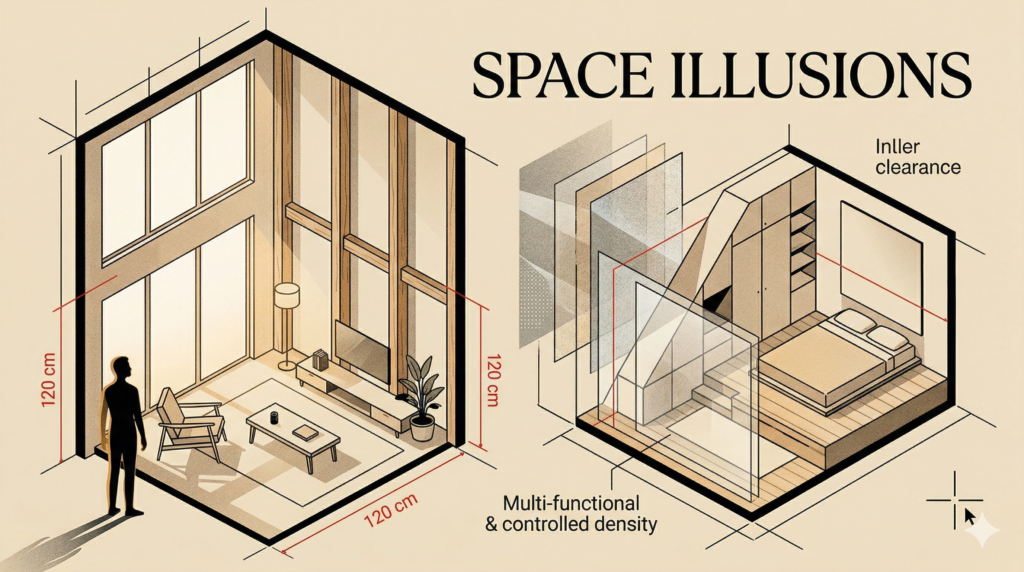
- Chair Clearance (Crucial!): To push your chair back and stand up, you need at least 75 cm of space between the table edge and the wall (or the nearest piece of furniture). If someone needs to walk behind your pushed-back chair while you are getting up, that distance needs to increase to 120 cm.
4. Kitchen Ergonomics & The Work Triangle
The kitchen is a workspace. Functionality is everything, and the “Work Triangle” (the path between your sink, stove, and fridge) rules supreme.
Counters and Cabinets
- Counter Height: Standard height is 85-90 cm to prevent lower back pain while chopping vegetables.
- Counter Depth: A standard 60 cm.
- Upper Cabinet Clearance: Leave 50-60 cm of breathing room between your countertop and the bottom of your upper cabinets.
- The Aisle: If you have an island or a galley-style kitchen, you need at least 120 cm between the two facing counters. This allows two people to cook at once and gives you enough room to fully open lower cabinet doors and ovens.
Pro Tip: When your dishwasher door is fully open and laying flat, you still need about 60-70 cm of clear space in front of it to load and unload comfortably.
5. Bedroom Standards
A bedroom should feel like a sanctuary, which means avoiding that cramped, claustrophobic feeling at all costs.
Bed Sizes and Spacing
- Single Bed: Usually 90×190 cm or 100×200 cm.
- Double Bed: 140×200 cm is the absolute minimum, but for actual sleeping comfort for two adults, 160×200 cm or 180×200 cm is ideal.
- Walking Around the Bed: To comfortably walk around the room and make the bed without doing acrobatics, leave at least 60-70 cm of clear space between the sides/foot of the bed and the walls.
Wardrobes
- Wardrobe Depth: If you want your winter coats, suits, and shirts to hang straight without the sleeves getting crushed in the door, the internal net depth of your closet must be exactly 60 cm.
6. Bathroom & Wet Areas
Bathrooms are usually the smallest rooms in the house, which means centimeter-level precision is required.
- Sink Height: Sits at 85-90 cm off the floor.
- Toilet Space: You need a minimum total width of 80 cm for a toilet (meaning 40 cm from the center of the bowl to the left, and 40 cm to the right). You also need a minimum of 60 cm of clear empty space right in front of the toilet for your legs.
- Shower Area: While 80×80 cm is technically accepted as a minimum, Neufert guidelines strongly recommend 90×90 cm or larger so you can actually wash your hair without slamming your elbows into the glass.
Quick Reference Summary Table
| Area / Furniture | Standard Width / Depth | Standard Height | Required Clearance (Minimum) |
| Dining Table | 60 cm (per person) | 75 cm | 75 cm (behind chair to pull out) |
| Kitchen Counter | 60 cm (depth) | 85-90 cm | 120 cm (aisle between counters) |
| Wardrobe | 60 cm (internal depth) | 210-240 cm | 60-70 cm (front clearance to open) |
| Interior Doors | 80-90 cm | 210 cm | 90-degree swing area |
| Hallways/Corridors | 100-120 cm | – | – |
Why Should You Follow These Rules?
Following Neufert’s standards isn’t about being rigid; it’s about guaranteeing fluidity, safety, and comfort in your home. A poorly measured kitchen counter will literally give you back pain, and a cramped dining room will cause subconscious stress during every meal.
Before you buy your next sofa or plan a renovation, grab a tape measure and apply these standards to your space. Remember: good design is completely invisible. You only notice it when your daily life suddenly feels perfectly effortless.